On 9 September 1835, a new law in Britain outlawed 'sports' such as bull baiting. (A bull was chained to a post and dogs were trained to attack it. Some butchers would not sell bull meat unless the bull had been bitten by dogs. They said it made the meat more tender). The new law also banned cockfighting and dogfighting. Of course, making them illegal and actually stopping them were two different things but it was a step in the right direction.
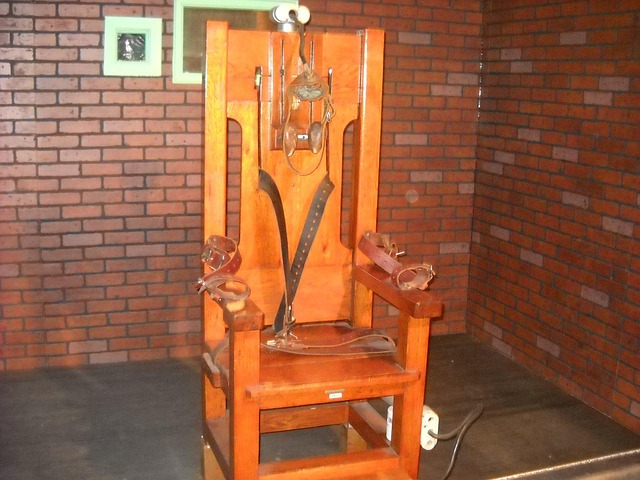
Martha Place was the first woman to be executed by the electric chair. She murdered her stepmother and attempted to murder her husband.
Martha was born on 8 September 1849 in New Jersey, USA. Her birth name was Martha Garrettson. Martha married Wesley Savacool, and they had a son. But the marriage was short-lived. Wesley left, and Martha could not look after her son. So she agreed to have him adopted.
In 1893, she married William Place. He had a teenage daughter named Ida from a previous marriage, and it seems Martha was very jealous of her. She resented the girl because she was very popular and she was close to her father. She also wanted her son to come and live with them, but Place refused, much to Martha’s annoyance. The couple grew apart.
On 7 February 1899, Martha had a row with 17-year-old Ida. Martha threw carbolic acid in Ida’s face. She then killed the girl by suffocating her. attacked William Place with an axe when he came home from work. Place managed to escape and summon help.
When William Place came back from work, Martha attacked him with an axe. Fortunately, William survived. Martha ran upstairs, perhaps thinking William was dead. He managed to stumble outside, where neighbours saw him and called the police.
The police found Martha unconscious. She had attempted to kill herself by turning on gas taps. The police also found the dead body of Ida Place. Martha was, at first, taken to a hospital, but when she recovered, she was charged with the murder of Ida and the attempted murder of William.
At her trial, Martha claimed to be innocent. However, not surprisingly, the jury did not believe her and she was found guilty. Martha was sentenced to death. The governor of the state of New York, Theodore Roosevelt, refused to commute her sentence to life imprisonment. On 20 March 1899, Martha Place was executed in the electric chair at Sing Sing prison.
In England, the first law against witchcraft was passed in 1542. It was repealed in 1547 but was replaced by a new law in 1563. The first person in England to be executed for witchcraft was Agnes Waterhouse in 1566. Sadly, many other men and women followed.
On 17 August 1612, the Pendle Witch Trials began. (Pendle is a place in Lancashire, England). On 20 August 9 people (7 women and 2 men) were hanged. (In England witches were hanged not burned). 😢
The last person to be executed for witchcraft in Britain was Janet Horne. She was burned in Dornoch, Scotland, in 1727. Her daughter had some abnormalities in her hands and feet. Neighbours said they looked like hooves. They claimed Janet turned her daughter into a pony and used her for transport when she was going to a meeting of witches. However, the girl had not completely transformed back into a human being. Janet herself was probably mentally ill, as she did not seem to have understood what was going on.
I often hear this myth. This myth refuses to die. In the past, a man had a right to beat his wife provided he did not use a stick thicker than his thumb.
There has never been a rule or a law in England that a man is entitled to beat his wife provided he uses a stick no thicker than his thumb. William Blackstone (1723-80) wrote Commentaries on the Laws of England (1765-1769). He made no mention of a supposed rule that a stick could be used to hit your wife if it was not thicker than a thumb. So it was never a part of English common law.
We are not certain how the phrase ‘rule of thumb’ arose but it probably came from craftsmen using their thumbs to measure.
On 13 November 1887, a mass demonstration was held in Trafalgar Square in London. That year the unemployed held a number of demonstrations there. Eventually, the police banned demonstrations in the square. A demonstration was planned for Trafalgar Square on 13 November.
(The demonstration was first called to demand the release of an Irish MP who had been jailed for supporting a rent strike. But many people went to defend the right to demonstrate). Police and troops were sent in to clear the square and in the ensuing violence, two men died. The event became known as Bloody Sunday.
For centuries the Tower of London was used to hold important prisoners. The first was Ranulf Flambard the Bishop of Durham. When King William Rufus was killed in 1100 his brother became Henry I. The new king promptly arrested the bishop for simony (selling positions in the church for money).
However, the bishop escaped. He was allowed certain privileges such as being able to buy his own food and wine. On 2 February 1101, the bishop generously invited his guards to a feast. When the guards became drunk he managed to squeeze through a window and climb down a rope. However, the rope was not long enough and he had to drop the final distance. The bishop was met by friends who rowed him across the river and he then rode a horse to the coast where he escaped on a ship.
In 1860 a teacher named Thomas Hopley beat a boy to death. The boy was 14-year-old Reginald Chancellor and he had a learning disability. Among other things, the teacher hit him with a candlestick because he could not repeat the multiplication table.
The teacher was charged with manslaughter, not murder because the intent to kill could not be proved. He was sentenced to 4 years in prison. Discipline in the 19th century was brutal but even by their standards beating a child to death was going a bit too far.
Corporal punishment was made illegal in state schools in Britain in 1987. It was made illegal in private schools in 1999.