Did Jack the Ripper strike in Havant?
Sunday, 5 July 2026

Friday, 3 July 2026
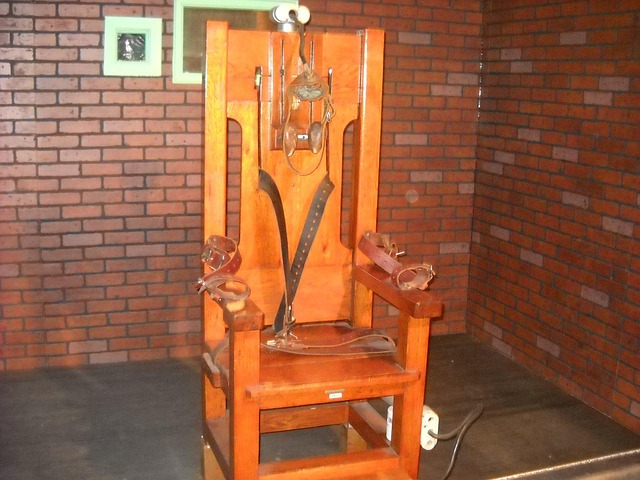
Martha Place - the first woman executed in the electric chair
Martha Place was the first woman to be executed by the electric chair. She murdered her stepmother and attempted to murder her husband.
Martha was born on 8 September 1849 in New Jersey, USA. Her birth name was Martha Garrettson. Martha married Wesley Savacool, and they had a son. But the marriage was short-lived. Wesley left, and Martha could not look after her son. So she agreed to have him adopted.
In 1893, she married William Place. He had a teenage daughter named Ida from a previous marriage, and it seems Martha was very jealous of her. She resented the girl because she was very popular and she was close to her father. She also wanted her son to come and live with them, but Place refused, much to Martha’s annoyance. The couple grew apart.
On 7 February 1899, Martha had a row with 17-year-old Ida. Martha threw carbolic acid in Ida’s face. She then killed the girl by suffocating her. attacked William Place with an axe when he came home from work. Place managed to escape and summon help.
When William Place came back from work, Martha attacked him with an axe. Fortunately, William survived. Martha ran upstairs, perhaps thinking William was dead. He managed to stumble outside, where neighbours saw him and called the police.
The police found Martha unconscious. She had attempted to kill herself by turning on gas taps. The police also found the dead body of Ida Place. Martha was, at first, taken to a hospital, but when she recovered, she was charged with the murder of Ida and the attempted murder of William.
At her trial, Martha claimed to be innocent. However, not surprisingly, the jury did not believe her and she was found guilty. Martha was sentenced to death. The governor of the state of New York, Theodore Roosevelt, refused to commute her sentence to life imprisonment. On 20 March 1899, Martha Place was executed in the electric chair at Sing Sing prison.
Ruth Ellis - the last woman hanged in Britain
Ruth Ellis was the last woman to be hanged in Britain. She was born on 9 October 1926 in Rhyl, Wales. She was one of six children. When she was 17, she had a son by a Canadian soldier.
After the Second World War, Ruth was living in London. In the 1940s, she worked in factories but she could not earn enough to support herself and her son. Ruth became a nude model and by 1950 she was an escort. In 1950 she married a man named George Ellis. They had a daughter but the couple soon separated. However, by 1953 Ruth had a job as manager of the Little Club in Knightsbridge. It was there that she met David Blakely.
Blakely was a racing driver. He was also a heavy drinker. He moved in with Ruth even though he was engaged to another woman. Ruth met another man, Desmond Cussen, and she moved in with him. Ruth and David Blakely continued their relationship, although they were both seeing other people. Blakely was abusive.
He asked Ruth to marry him, but she had a miscarriage in January 1955 after Blakely punched her in the stomach. Blakely later decided he never wanted to see Ruth again.
On 10 April 1955 Ruth took a taxi to a flat where she knew Blakely was staying. As they arrived, she saw him drive off in his car. She paid the taxi driver and walked to the Magdala Tavern where she thought he would be. Ruth waited till Blakely emerged from the pub. She drew a revolver from her handbag, and as he searched for his car keys, she shot him. Ruth fired six bullets at Blakely. The first shot missed. The second shot hit him and caused him to fall to the ground.
She fired three more bullets into him. Her last shot ricocheted off the ground and hit a bystander in the hand.
Ruth was immediately arrested by an off-duty policeman. Psychiatrists who examined her found she was not insane. Ruth went on trial on 20 June 1955. There was no doubt that she shot David Blakely. The prosecution merely had to prove the intent to kill. The prosecution lawyer asked, 'When you fired the revolver at close range into the body of David Blakely, what did you intend to do?' Ruth answered, 'It's obvious that when I shot him I intended to kill him'.
The jury found her guilty of murder, and she was sentenced to death. However, many people felt that her sentence should be commuted to life imprisonment. A petition was signed by 50,000 people, but the Home Secretary refused to grant a reprieve, and Ruth Ellis was hanged on 13 July 1955.

Guenther Podola - the last man hanged for killing a policeman
Guenther Podola was the last person to be hanged in Britain for the murder of a policeman. He was born in Berlin, Germany, on 8 February 1929. In 1962, he moved to Canada but he was deported for burglary. He then moved to Britain. Podola arrived on 21 May 1959.
Podola burgled Verne Schiffman's flat, stealing jewellery and furs worth £2,000 (a huge sum in those days). Later, bizarrely, he tried to blackmail her. He wrote to her claiming he had photos and tape recordings of her. He did not. Since she had nothing to hide Mrs Schiffman told the police. (Why Podola tried to blackmail her when she had nothing to hide is a mystery. If he had not done something so strange, he might well have got away with the burglary).
On 13 July 1959, Podola phoned her from a public phone box and again he tried to blackmail her. This time her phone was tapped and Mrs Schiffman kept him talking until the police traced the call. Two policemen, John Stanford and William Purdy arrested Podola at the phone box. However, Podola broke free and ran into a nearby block of flats.
The police captured him again and one of them, Stanford, went to fetch the patrol car. Podola then produced a gun and shot William Purdy.
Podola fled the scene, and he hid in a hotel for the next three days. However, in the dead policeman's pocket was an address book. It belonged to Podola. He must have dropped it when he was arrested, and the policeman picked it up. The police soon identified the book's owner and traced him to the hotel where he was hiding. On 16 July 1959, armed police went to the room occupied by Podola, and they forced open the door. Podola, who was standing by the door, was hit on the head as it opened and was knocked unconscious.
When he recovered, Podola said he had no memory of shooting a policeman. Before, he was tried for murder; a court hearing was held to decide if he was fit to stand trial. A jury had to decide if he was genuinely suffering from amnesia. Expert witnesses testified for both the prosecution and the defence, but after retiring for three hours the jury decided he was faking it. Podola then went on trial for murder. He still claimed he could not remember what happened, but he was found guilty and was sentenced to death on 26 September 1959.
Guenther Podola was hanged on 5 November 1959.

Thursday, 2 July 2026
Charlotte Bryant - murder by weed killer
Charlotte Bryant was convicted of poisoning her husband with arsenic. She was born in Derry, Northern Ireland, in 1903. In 1922, she met a British soldier named Frederick Bryant. The two married, and after leaving the army, Frederick worked as a farm labourer. Charlotte had five children, though they may not all have been Frederick's. In 1933, a horse trader named Leonard Parsons began lodging with the Bryants. He also began sleeping with Charlotte.
Frederick Bryant accepted the situation. In May 1935, he fell ill. A doctor was called and he diagnosed gastroenteritis. This time Fredrick recovered. However, he fell ill again in August 1935. Once again, he recovered. Leonard Parsons left their home in November 1935.
On 21 December 1935, Frederick fell ill for the last time. He complained of severe stomach pains. A doctor was called and Frederick was taken to a hospital. He died on 22 December 1935. An autopsy showed he died of arsenic poisoning.
The police naturally suspected his wife, Charlotte. A search of her house revealed a burnt can of weed killer in the garden. It contained traces of arsenic. The police discovered that a chemist in the town of Yeovil had sold the weed killer. The law required anyone who purchased arsenic weed killer to sign a poison register. Whoever bought the weed killer had signed the register with an X. Charlotte Bryant was illiterate. She was made to stand in an identification parade, but the chemist did not pick her out.
On 10 February 1936, Charlotte Bryant was charged with murder. On 27 May 1936, she went on trial in Dorchester. A witness named Lucy Ostler said that on 21 December 1935 she saw Charlotte give Frederick a drink. Later, he vomited and complained of stomach pains. Lucy said she found a burned weed killer can in the ashes of a boiler and she threw it in the garden.
A chemist testified that he found an abnormally large amount of arsenic in the ashes under the boiler, far more than he would normally expect to find. It was evidence that someone had tried to burn something containing arsenic in the boiler. Leonard Parsons was also called as a witness and he claimed he had seen Charlotte with some weed killer.
The court also heard about Charlotte's relationship with Parsons, which did not help her case. (It was, after all, the 1930s, when attitudes were far less liberal than they are today). On 30 June 1936, Charlotte Bryant was found guilty of murder and was sentenced to death.
However, a different chemist said that the expert at the trial had greatly overestimated the amount of arsenic in the ashes in the boiler. That would, of course, undermine the claim that Charlotte had tried to burn a can of weed killer in the boiler. The defence appealed against the guilty verdict but the appeal was dismissed. She was hanged on 15 July 1936.
While awaiting execution, Charlotte began learning to read and write, with help from the prison guards. She wrote a letter in which she named the person who, she believed, poisoned Frederick. However, the prison authorities redacted the name. It remains unknown if she was guilty or not.

Subscribe to:
Posts (Atom)